Most of us travel too fast.
We move between cities in days, between countries in weeks, collecting photographs and ticking landmarks off lists. We arrive home with a camera roll full of sunsets but very little sense of the places we passed through. Somewhere along the way, travel started to feel more like consumption than connection.
A different kind of journey is taking shape in the tea country of Assam — one that pushes back against the rush and is steadily redefining Assam tea tourism for modern travelers seeking deeper experiences.
The Case for Slowing Down
Slow travel is not a new idea, but Assam makes it feel essential. The pace of the gardens themselves seems to insist on it. Tea is a crop that rewards patience: leaves are still plucked by hand, two leaves and a bud at a time, in a rhythm that has barely changed in over a century. You cannot rush a cup of Assam tea, and the region seems to ask the same of its visitors.
At Purvi Discovery, the journeys are built around this rhythm. Days unfold without a packed itinerary. There is time to sit on a bungalow verandah and watch the mist lift off the gardens. Time for unhurried conversations with the people who actually live and work there. Time to let a place make an impression instead of demanding one.
For travelers exploring Assam tea garden tours, this slower pace becomes part of the experience itself.
A Region Shaped by Many Hands
Part of what makes Assam reward this slower pace is how layered it is.
The state's tea industry began in the 1830s, when the British East India Company developed commercial plantations in Upper Assam after losing its hold on the Chinese tea trade. But the gardens that exist today were not built by planters alone. From the 1860s onward, workers were brought in from regions of present-day Jharkhand, Odisha, Chhattisgarh, West Bengal, and Andhra Pradesh — communities now known collectively as Assam's tea tribes, whose descendants still form the backbone of the industry.
Their cultural footprint is everywhere once you start looking. The Jhumur dance, performed at celebrations across the tea-garden communities, carries rhythms from those original homelands. The food in worker villages blends Assamese ingredients with traditions brought from central India. Even the everyday language of the gardens — a hybrid known as Sadri or Baganiya — is its own quiet record of this history.
Then there is the older Assam, the one that existed long before any of this: the Ahom kingdom that ruled the Brahmaputra valley for nearly 600 years, the Vaishnavite satras of Majuli Island, the Bihu festival that still marks the Assamese new year with music and dance every April. None of this fits into a one-day visit. All of it is part of why people stay longer than they planned.
What You Actually Do on a Slow Journey
The Purvi Discovery experience is built around presence rather than performance.
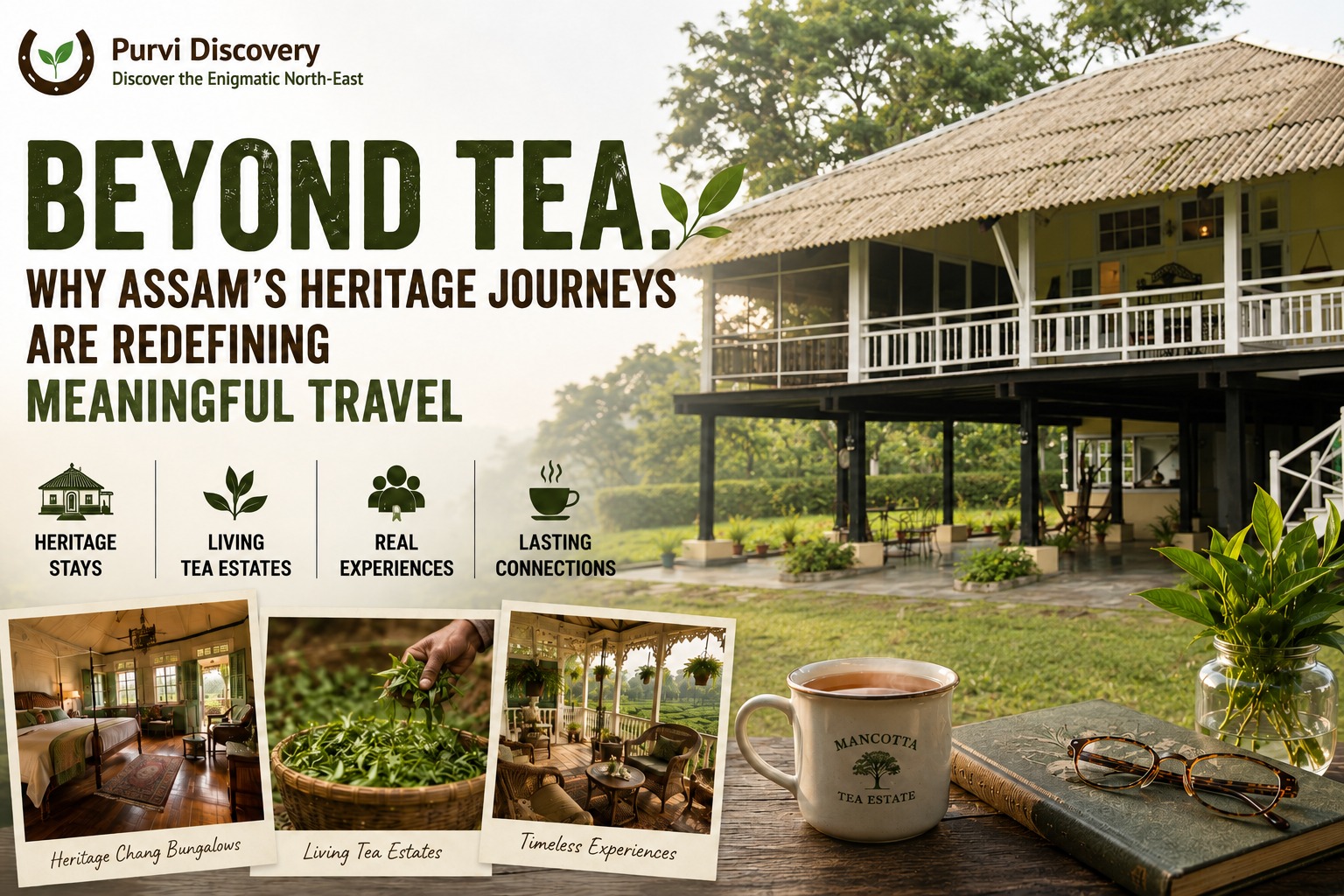
You stay in heritage chang bungalows — raised stilt structures from the colonial planter era, restored to keep their character without turning them into museums. Mancotta and Chowkidinghee, both on the outskirts of Dibrugarh, are working tea estates first and guest properties second; the rhythm of the garden continues around you.
You walk the gardens with people who have spent their lives in them. You watch tea being processed — withering, rolling, oxidising, drying — and taste the difference between a first flush and a second flush in the same afternoon. You sit in the Jorhat Gymkhana Club, one of the oldest clubs in India, and notice how the planter-era architecture still shapes daily life.
Experiences like these are what make Assam tea tourism feel authentic rather than curated. Thoughtfully designed Assam tea garden tours allow travelers to engage with the region beyond sightseeing and into lived heritage.
And in between, you do less than you would on a typical trip. That is the point.
Why It Stays With People
Travelers who choose this kind of journey often say the same thing afterward: the trip changed how they travel in general. Not because Assam is more beautiful than other places — though it is beautiful — but because the experience reminded them what travel can be when it is not rushed.
Connection takes time. So does understanding a place beyond its surface. The tea gardens of Assam are an unusually good teacher of both.
In a world where travel often feels transactional, slow heritage journeys offer something simpler and rarer: the chance to actually be somewhere.
Plan a Journey That Moves at Its Own Pace
At Purvi Discovery, we design unhurried, immersive Assam and Northeast India trips for travelers who want depth over distance. Tea estates, heritage bungalows, cultural encounters, and time to absorb it all through carefully curated Assam tea garden tours and memorable Assam tea tourism experiences.
Slow down, sip deeper, and discover the soul of Assam with Purvi Discovery’s immersive Assam tea garden tours.